1
/
of
1
RSB AQUATICS
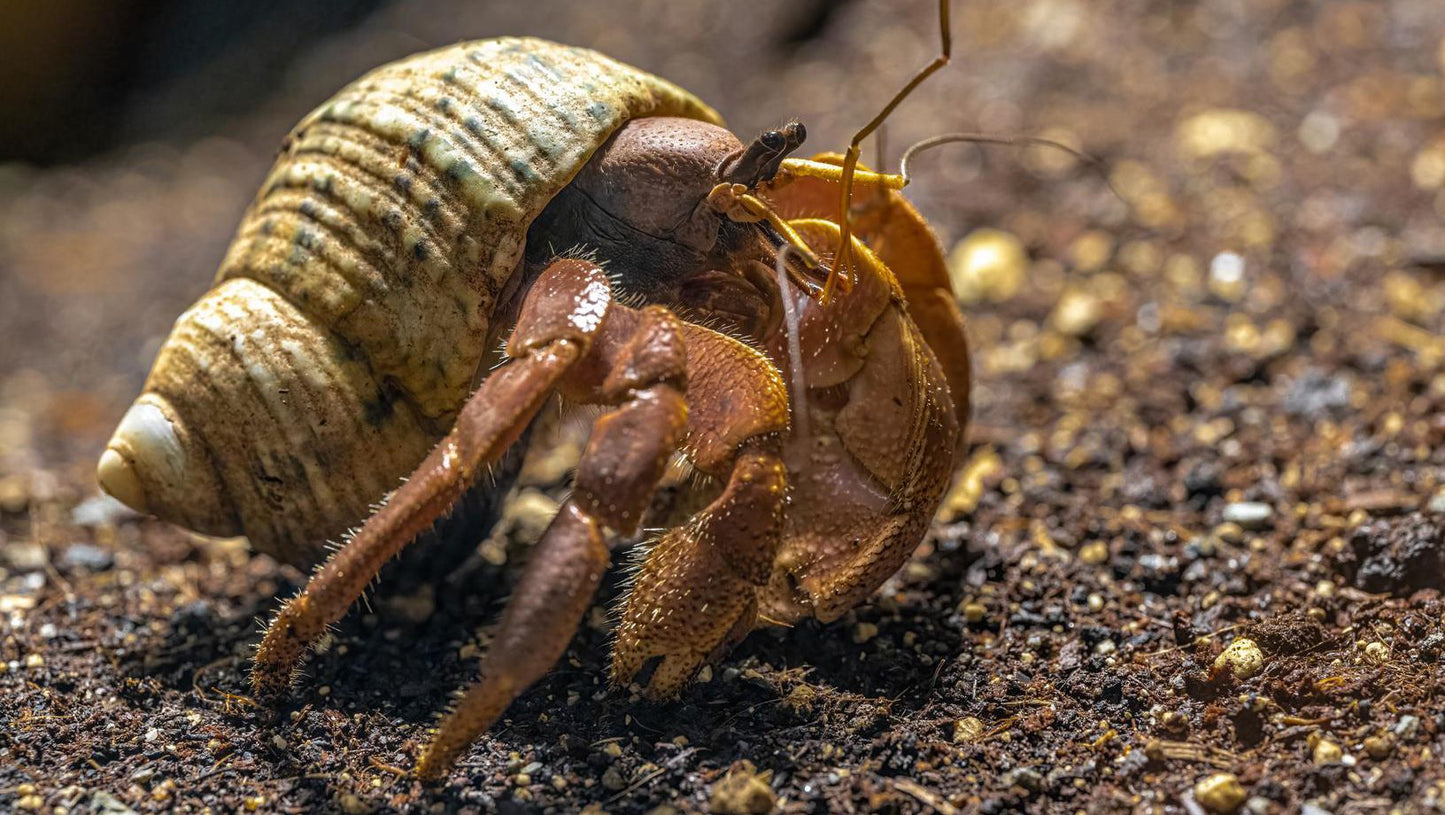
Land Hermit Crab
Land Hermit Crab
Regular price
R 650.00 ZAR
Regular price
R 950.00 ZAR
Sale price
R 650.00 ZAR
Unit price
/
per
Shipping calculated at checkout.
Couldn't load pickup availability
Creating a “Crabitat”
Hermit crabs are unique pets with complex needs. These little crabs can live for 40 years or more with the right care! At its most basic, a good “crabitat” provides everything your crab needs to thrive. Hermit crabs need a warm, humid environment with deep sand to burrow in, lots to explore, freshwater and saltwater pools to take a dip in, lights, and food bowls.
Choosing a Tank:
Hermit crabs need a deep layer of substrate, usually 6” minimum or 3 times deeper than your largest crab is tall (including the shell). For adult crabs, your substrate will be 12-14” deep! Glass aquariums are the best option to handle the weight of that much substrate. Fish tanks work really well, and while you can start with 5 gallons per crab, as your crabs grow, they’ll need 20 gallons per crab! In the wild, hermit crabs will walk miles in a night, so they’ll love a bigger enclosure to explore.
You’ll also want a glass lid to keep the humidity in your tank. Screen lids give great air flow, but that air flow can remove vital humidity from your crabitat.
Selecting Substrate:
Hermit crabs burrow to molt so they need a nice deep substrate that stays moist and holds a burrow. That’s a lot to ask of substrate! Fortunately, the Fluker’s Hermit Crab Beach Sand Substrate is a premixed substrate available at PetSmart! Another common choice is to use 1 part Eco Earth and 5 parts sand, such as play sand. Avoid fine aquarium sand or calcium sand as these don’t hold a burrow without additional additives.
For small hermit crabs, 6” is a great starting depth. For larger hermit crabs, 12” to 14” is required. You’ll want to moisten the substrate, but it should never be wet. A good way to tell is to take a handful and press it tightly in your fist. It should be slightly crumbly but still hold its shape. If you squeeze and water comes out between your fingers, that’s too wet. If the substrate is wet, that’s considered a flood and requires removing your hermit crabs to replace or dry your substrate. This very wet substrate can drown your hermit crab when they burrow either to molt or to explore.
Heating:
Most hermit crabs prefer to remain in the 80-85°F (26-29C) range. To achieve a consistent temperature in that range, you can use an under-tank heater attached to the back of the tank to radiate warmth into the tank. You’ll use the heater on the back and not under the tank because the heat can’t penetrate through that depth of sand. As a best practice for all heating in habitats, attach the heater to a thermostat with a probe placed slightly above the substrate towards the center of the tank to get an accurate reading. Set the thermostat to turn off at 85°F to keep your crabs nice and cozy.
Humidity:
Most hermit crabs need a minimum 80% humidity but prefer to remain in the 85% range. However, if humidity is too high, condensation can form on the top and sides of the tank and lead to flooding the substrate. Monitor your humidity using a digital hygrometer and if you notice a lot of condensation on the walls, vent your tank by opening the door or the top.
To maintain the humidity, keeping the substrate as above is vital. If that’s not enough to maintain humidity levels, you can add an air pump and air stone to the pools to increase evaporation from the pools and/or add bowls filled with damp sphagnum moss.
Share